The One Thing I Do Badly on Purpose: Notes From the Sunday Crossword
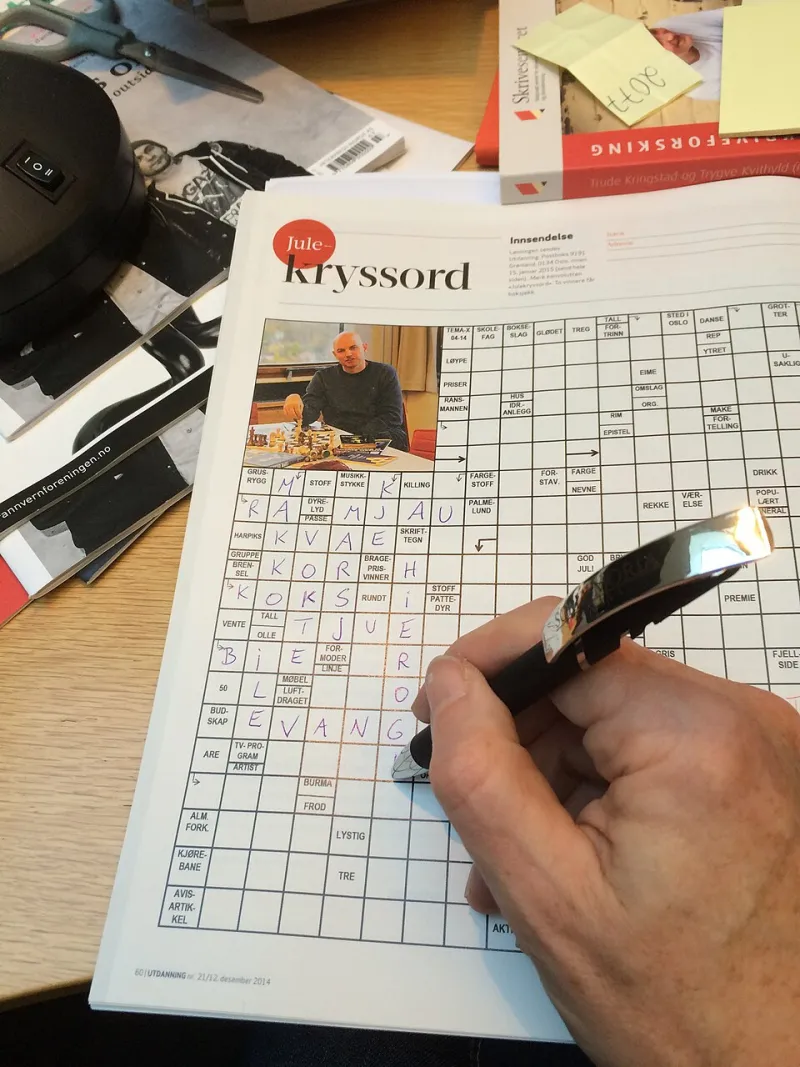
Photo: guaca, CC BY-SA 3.0, via Wikimedia Commons
There is a particular kind of quiet that settles over my kitchen table around 8:30 on a Sunday morning. The coffee goes cold in stages. The dog is doing whatever the dog does. And I am staring at 1-Across with a ballpoint pen in my hand and no plan whatsoever.
That is the Sunday crossword. Not the app, not the grid on my phone with the button that announces my mistakes the second I make them. The paper one. The one that folds funny and shows the coupon insert through the back.
I want to say this up front, before anyone assumes this is a post about getting good at something: I am not good at it. I finish maybe half of them. The other half sit on the table until Wednesday, half-filled, quietly judging me from under the mail.
The Five-Minute Window of Total Confidence
Every puzzle opens the same way. I look at the first few clues, decide this one is on the easy side, and start writing like a person who has never been wrong about anything. Five minutes later I am stuck on a four-letter word for a unit of currency that apparently only exists in crossword puzzles, and the confidence has left the building.
What I've learned is that the opening confidence is part of the ritual. It's the same little burst of optimism I get walking into a hardware store, or opening a recipe with eleven ingredients. The fall is coming, and it's fine. The fall is actually the fun part.
Pen Is a Commitment, Not a Flex
Pencil people are the sensible ones. They plan. They have erasers. They can revise. I respect them deeply and I am not one of them.
Pen means you have to live with your answer. If I put down a wrong surname in block letters at 14-Down, that wrong surname is now part of the puzzle, and every crossing word has to negotiate with it. The grid becomes a small record of how I thought at 8:47 a.m. There are cross-outs, a word squeezed over another word, an arrow pointing nowhere, and one margin note that just says NO in my own handwriting.
Some Sundays there's a small blue smudge on my thumb by the time I'm done. That smudge is, honestly, one of the better things I produce all week.
Crosswords Have Their Own Dialect
Stick with it a few months and you start learning the language. Four letters for a Great Lake is almost always the same answer. So is a three-letter Irish playwright, a three-letter art movement, and a word for a type of passage that no human has said out loud since roughly 1950.
It's a little bit like learning the nicknames for streets in your own town — the ones only locals use. Nobody teaches them to you. You just hear them long enough and eventually you know that when someone says the old depot, they mean the parking lot behind the bank.
The crossword is the same. It's a dialect, and it's older than I am, and after a while it starts to feel like company.
Help Arrives Whether You Want It or Not
Here's the part the apps can't do. Around 9:15 my wife walks through with a second cup of coffee and glances at the grid, and says, 'That's not a river, that's a mountain range,' and keeps walking. My kid stops by to ask what a word means, then answers the clue for me without realizing it. Once a neighbor dropped off a ladder and solved 43-Across on his way back to his truck.
The puzzle becomes a table thing, not a solo thing. Somebody else always wanders past. The dog has contributed nothing but is present for all of it.
No Streak, No Stats, No Nudge
Most of my week is measured. Steps, emails, screen time, a little weekly report card from my phone telling me I'm up seventeen percent. The crossword measures nothing. It does not know if I finish. It does not send a sad notification at 9 p.m. reminding me I abandoned it.
If I leave a puzzle half-done, the paper simply sits there. It has no opinion. That is a rare and precious quality in an object in the year 2026.
The Grid That's Still There on Tuesday
I used to think an unfinished puzzle was a failure. Now I think of it as a bookmark. A Tuesday night with pasta water coming to a boil is a great time to fill in three squares and finally crack a clue about a 1990s sitcom. Some puzzles get finished Thursday. One memorable grid got finished in a waiting room the following week.
The week has a shape, and the puzzle sits across it like a loose stitch.
The Cheapest Good Hour I've Found
The Sunday paper costs less than a sandwich. The library has papers, and so does the coffee shop on the corner if you buy something and don't hog the table too long. Some neighbors pass their puzzles along like tomatoes from a garden.
For that price I get an hour where my hands are busy and my brain is pleasantly annoyed and nothing is beeping at me. No autoplay. No recommendation engine suggesting a puzzle I might also like. Just ink, newsprint, and the slow business of remembering that being mediocre at something is allowed.
If You Want to Try It
Take the pen. Skip the timer. Start with the fill-in-the-blank clues, because those are gifts. Do the short stuff around the edges before the long answers in the middle. Read the clues out loud if you get stuck — it sounds silly and it works more often than it should. And leave it out on the table when you walk away, because you'll come back to it, and coming back to it is most of the point.
Sunday's puzzle will be waiting next weekend, slightly bigger than I want it to be. I'll open the paper, decide it looks easy, and be wrong within five minutes.
Can't wait.