Game Night, Minus the Meltdown: Five Boxes That Survive My Family's Table
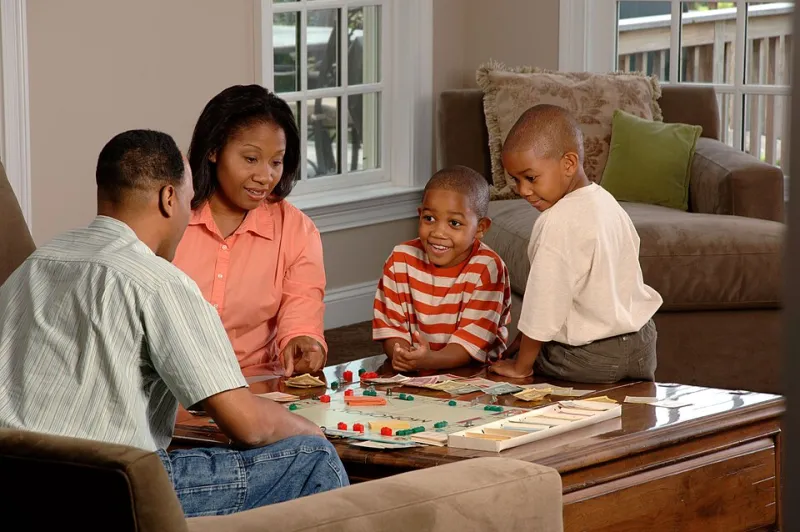
Photo: Bill Branson (Photographer), Public domain, via Wikimedia Commons
My family did Thanksgiving at our house this year, which meant twelve people, one table leaf we had to dig out of the garage, and the annual question of what to do with everybody between the dishes and the pie. We've been through a lot of games over the years. Some have become traditions. One has become a cautionary tale.
Before I get to the list, here are the rules I use to judge whether a game belongs on a family table. Your family is different from mine, but I'd bet the criteria aren't.
The Five Rules
- The rules explanation has to fit in five minutes. Not five minutes with a rulebook open. Five minutes out loud, from memory, while someone is already dealing.
- No turn should take longer than a minute. The second somebody starts thinking for three minutes, everyone else pulls out a phone and the evening is over.
- No app, no QR code, no scanning. The box should work if the wifi goes down and the phone is in the other room.
- Losing shouldn't be humiliating. A game where the loser gets publicly dunked on is a game my nephew will not play twice.
- Cleanup under five minutes. If packing it away requires a diagram, it's not a family game. It's a commitment.
With that out of the way:
1. Sushi Go! — the one that gets played twice
You draft cards, you pass the rest to your left, you collect sets of little cartoon sushi. That's it. People who claim they hate games will play this, because there's no board to study and no long-term strategy to feel behind on.
Two Thanksgivings ago my aunt — a woman who has described herself as "not a game person" for roughly forty years — won the first round and then asked to play again before I'd finished reshuffling. That's the whole advertisement, honestly. It handles three to five players, plays in fifteen minutes, and fits in a bag the size of a paperback.
Watch out for: the scoring symbols are small. If someone at the table needs reading glasses and doesn't have them, pair up.
2. Qwirkle — the one for readers and non-readers alike
Wooden tiles with colored shapes. You match either color or shape. No words, no numbers, no reading at all, which makes it the single best option we've found for a table with a kindergartener at one end and a grandmother with macular degeneration at the other. Both can play it at full strength.
My father-in-law, who generally views any game as a slightly rude way to pass an evening, has won this one three years running. He calls it "the tile thing." He now requests it.
Watch out for: the score pad. Somebody has to do the math, and it's always the same somebody. Rotate the job.
3. Kingdomino — the one that ends before anyone gets restless
Each player builds a little five-by-five kingdom out of domino-like tiles, matching terrain types. It takes about fifteen minutes and, crucially, the last turn is as interesting as the first — there's no slow, grinding endgame where two people know they've lost and have to sit there politely.
This is the game I hand to teenagers who have made it clear they'd rather be elsewhere. It's quick enough that they don't feel trapped, and it looks good enough on the table that it draws people over from the kitchen.
Watch out for: the score at the end has three or four little bonuses. Do it out loud, together, or someone will accuse someone else of cheating and mean it.
4. Telestrations — the one that produces the laughing
It's telephone, but with drawing. You sketch a word, pass the pad, the next person guesses, the next person draws the guess, and by round three you've got a picture of a "hot dog" that everyone is now calling a "sad walrus." No artistic ability required. In fact, some ability is a drawback.
The great thing about it is that it doesn't matter who wins. There's a scoring system in the box and I genuinely could not tell you how it works. Nobody has ever asked.
Watch out for: it needs four people minimum to be any fun, and six or more is better. Also, buy extra pads. You'll run out.
5. Codenames — the one for a crowd
Two teams, a grid of words, and one person per team giving a single-word clue that points at their team's words without pointing at the other team's or — critically — at the assassin. It handles six, eight, ten people, which makes it the go-to when the table has gotten too big for anything else.
We play it as couples versus couples, which is either the best or worst idea we've ever had, depending on which couple you ask. My brother and his wife have a private shorthand from twelve years of marriage that feels unfair.
Watch out for: one overly clever clue-giver can sink a whole team, and there will be a five-minute argument about whether the clue was legal. This is part of the game, but budget for it.
The One That Doesn't: Gloomhaven
Now the other side of the ledger. A few years back a well-meaning relative showed up with a box that could have doubled as a piece of carry-on luggage. If you know the game, you know. If you don't: it's a sprawling fantasy campaign with maps, tokens, sealed envelopes, and a rulebook that reads like a lease agreement.
Here's how that night went. Setup took forty minutes, spread across the dining table and part of the floor. Learning the rules took another half hour, during which two people quietly left. We played about twenty minutes of an actual game. Then my mother-in-law announced pie, and everyone stood up and never came back. Packing it away took almost as long as setting it up. The box has been in the hall closet since.
It's not a bad game. It's a fine game for two or three adults with a free Saturday and a table they don't need for anything else. It is not a Thanksgiving game. It's not even a Fourth of July game.
If I have to name the general principle: anything with a campaign, a legacy element, sealed components, or a setup time longer than its play time does not belong at a mixed-age family gathering. Save it for your friends.
And one dishonorable mention — the game in everyone's closet with the little metal tokens and the properties. You know the one. The problem isn't the rules, it's the length. Nobody has ever finished a game of it at my house, and one year it caused an argument about rent that lasted into the following spring. We keep it for sentimental reasons and we do not open it.
A Couple of House Rules That Help
Let kids team up with an adult rather than sitting out. Skip the deep strategy talk when a new player is learning — nobody learns a game while being coached by three people. And when the food comes out, put the box away without ceremony. Half the reason these games work is that they're easy to stop.